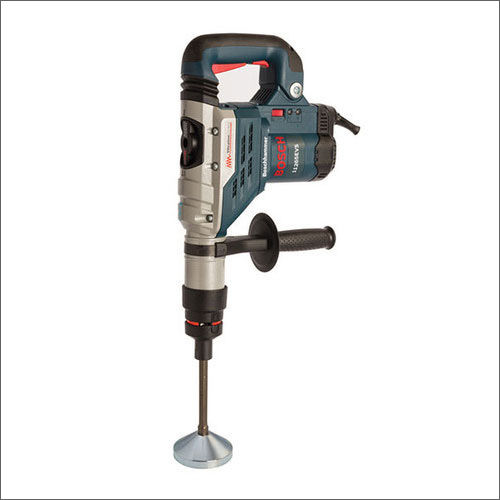
DLC Vibrating Hammer For Concrete Moulds About
We take pleasure to introduce ourselves as one of the renowned firms for providing the best-in-class range of DLC Vibrating Hammer For Concrete Moulds. They are generally useful for the compaction of concrete samples in a mould. Apart from these, provided moulds are found to be a much faster and quicker method as compared to impact hammering. DLC Vibrating Hammer For Concrete Moulds are supplied in a bulk quantity and in various specifications to our clients.
Optimized for Concrete Sample CompactionAchieve superior compaction of concrete specimens with the DLC Vibrating Hammer. Engineered for both cube and cylindrical moulds, this tool ensures consistent, effective results for laboratory-quality samples. Its high-performance motor and precise amplitude deliver optimal vibration for various standard mould sizes.
Engineered for Safety and DurabilityConstructed from engineering-grade steel with an insulated grip, the vibrating hammer is robust, reliable, and safe to use. The IP21 protection class and low noise output (below 70 dB) make it suitable for both industrial and laboratory environments, while its sturdy build guarantees long-lasting use.
User-Friendly, Portable DesignThis lightweight, handheld vibrating hammer features a 2-meter cable and standard European plug for quick setup and ease of use. Manual switch control and ergonomic structure ensure comfortable handling, enabling operators to efficiently compact concrete specimens wherever needed.
FAQ's of DLC Vibrating Hammer For Concrete Moulds:
Q: How is the DLC Vibrating Hammer operated during concrete specimen preparation?
A: The vibrating hammer is handheld and features manual switch control, allowing the user to operate and maneuver it directly over the concrete mould. Simply connect to a standard 230V AC power outlet, position it on the filled mould, and activate the vibration for effective compaction.
Q: What concrete mould sizes are compatible with this vibrating hammer?
A: This hammer is designed for cube and cylindrical moulds up to 150 mm, specifically accommodating 70.6 mm, 100 mm, and 150 mm standard moulds commonly used in laboratory settings.
Q: When should I use this vibrating hammer for sample compaction?
A: Utilize the vibrating hammer during the casting of concrete specimens in the mould to ensure thorough compaction, eliminate air pockets, and achieve accurate test results. It is best applied immediately after concrete is placed in the mould.
Q: Where is the DLC Vibrating Hammer typically used?
A: The vibrating hammer is widely used in concrete testing laboratories, industrial quality control departments, construction research institutes, and by manufacturers/suppliers involved in concrete sample preparation and compaction.
Q: What are the main benefits of using this vibrating hammer in concrete testing?
A: By providing optimized vibration amplitude and speed, the hammer helps in producing dense and homogenous concrete samples, minimizing air entrapment and improving the structural integrity of test specimens. Its portable design allows for convenient use in various environments.
Q: How do I maintain the DLC Vibrating Hammer for long-term performance?
A: After each use, clean the hammer head and handle to prevent residual concrete buildup. Regularly inspect the cable, plug, and grip insulation for any wear or damage, and store the unit in a dry, dust-free area to ensure longevity.
Q: What safety features does the vibrating hammer include?
A: The device incorporates an insulated grip for operator safety, operates at a low noise level (below 70 dB), and is rated at protection class IP21, making it suitable for laboratory and controlled industrial environments.









 Send Inquiry


 Send Inquiry


 English
 Spanish
 French
 German
 Italian
 Chinese (Simplified)
 Japanese
 Korean
 Arabic
 Portuguese