Concrete Permeability Apparatus About
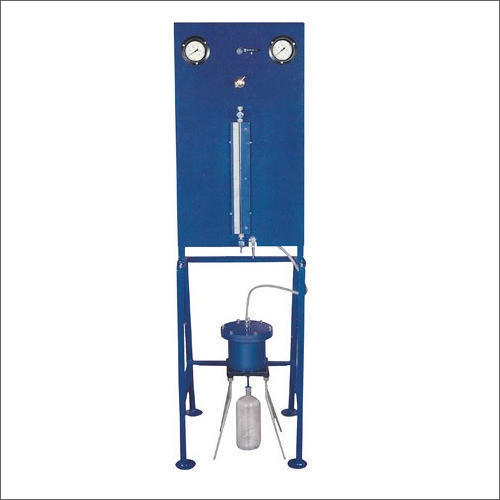
Supported by a team of professionals, we are coming with a wide range of Concrete Permeability Apparatus. It is to increases concrete strength which further improves its resistance to cracking his apparatus. Therefore, provided range helps to control the rate of moisture.Concrete Permeability Apparatus is to evaluate the case whereby concrete is subjected to hydrostatic pressure. It is to determine the coefficient of permeability and the rate of flow of water under laminar flow conditions.
Superior Chamber Construction for ReliabilityCrafted from mild steel and protected by an epoxy coating, the chamber resists corrosion in demanding laboratory conditions. The heavy-duty screw type clamping ensures specimens are securely fastened, and neoprene gaskets provide effective, long-lasting seals for accurate permeability testing. The robust construction allows multiple tests simultaneously without compromising performance.
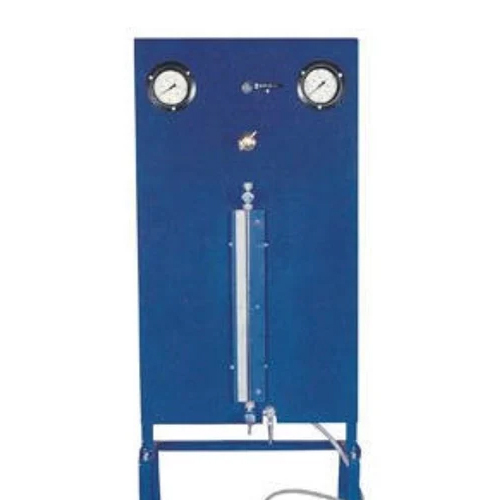
Advanced Control and Monitoring FeaturesEach cell of the apparatus is fitted with an individual analog pressure gauge, offering precise and immediate pressure monitoring during tests. The hydraulic system includes a dedicated water reservoir with test control valves, facilitating easy manual adjustment and regulation. This control scheme ensures consistent and dependable results for daily laboratory use.
Comprehensive Safety and MaintenanceSafety is integrated into every aspect of the design, with pressure relief valves and overpressure protection as standard. A complete accessory kit is provided, including calibration certificates, pressure hoses, rubber gaskets, and spanners. The included maintenance toolkit enables routine servicing, ensuring longevity and consistent device performance.
FAQ's of Concrete Permeability Apparatus:
Q: How does the Concrete Permeability Apparatus determine the permeability of concrete samples?
A: The apparatus measures the amount of water that penetrates through concrete specimens under controlled hydraulic pressure, using individual analog pressure gauges for each cell. This allows for precise quantification of concrete's permeability, conforming to IS 3085 and ASTM C1202 standards.
Q: What types and sizes of specimens can be tested with this apparatus?
A: This device is designed for laboratory testing of cylindrical concrete specimens with dimensions of 150 mm diameter by 150 mm height. It accommodates up to three samples simultaneously in its 3-cell chamber setup.
Q: Where is the Concrete Permeability Apparatus typically used?
A: It is used primarily in research and industrial laboratory settings by manufacturers, exporters, and quality control specialists to assess concrete durability and resistance to water ingress under pressure.
Q: What is the process for applying pressure and monitoring the test?
A: Pressure can be applied using a compressor or water sump, regulated through manual control valves. Each cell's pressure is constantly monitored via dedicated analog gauges, with a quick response time for adjustments throughout the test duration.
Q: How does the apparatus enhance safety during operation?
A: Integrated safety features such as a pressure relief valve and overpressure protection minimize risk during testing. The durable metal body and secure clamping system further reduce chances of accidental leaks or failures.
Q: What accessories come with the apparatus, and how do they aid usage and maintenance?
A: The apparatus is supplied with rubber gaskets, pressure hoses, a calibration certificate, spanners, Vaseline, and a complete toolkit. These components support straightforward setup, calibration, routine maintenance, and longevity of the device.
Q: What benefits does the apparatus offer for concrete testing?
A: With multipoint testing, corrosion-resistant materials, accurate analog gauges, and the ability to test multiple specimens at once, the apparatus offers reliable, repeatable permeability measurements crucial for concrete quality assessment and compliance verification.








 Send Inquiry


 Send Inquiry


 English
 Spanish
 French
 German
 Italian
 Chinese (Simplified)
 Japanese
 Korean
 Arabic
 Portuguese